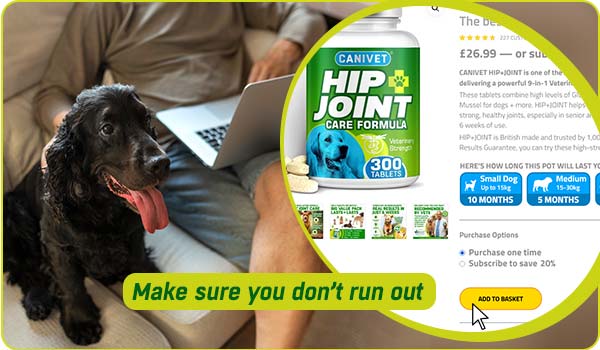
A practical guide to help your dog get the maximum benefits from their daily tablet routine.
-
The best way to give your dog their tablets
-
What results to expect week by week
-
Complementary care that multiplies the benefits
-
Top joint care hacks most people miss

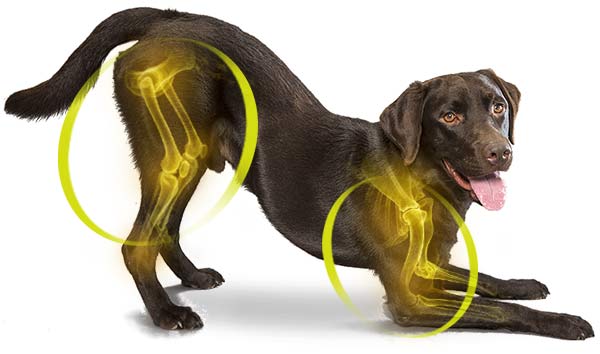
The most important thing to know about dog joint supplements is that they work best as part of a daily routine supported by smart lifestyle changes. If you use them as a short-term fix, occasional extra or without helping your dog in other ways you’ll never see the full benefits. CANIVET HIP+JOINT was formulated to provide real & lasting joint support, and it’s the owners that use them the most effectively that help their dogs the most!
This guide covers how best to serve the tablets, what to expect week by week, and the everyday tips that make the formula work harder. Plus, learn how a healthy weight, optimum exercise, a supportive bed, and options like hydrotherapy can really help get your dog’s bounce back. Put all of this into practice and you might be amazed by how well your dog responds.
How to give HIP+JOINT tablets
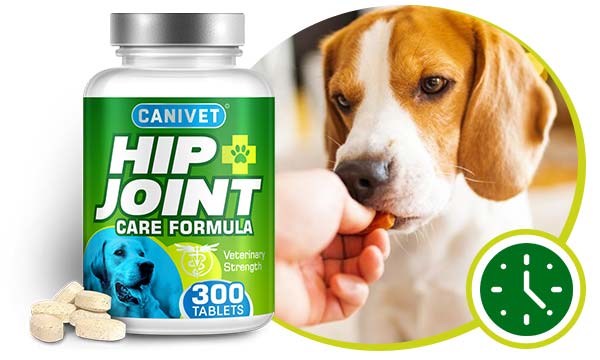
Give your dog their tablets with food every day. Breakfast or dinner both work. Adding it to a meal makes it easy to serve and keeps the routine consistent.
Give it at the same time each day. Pick the meal you rarely miss and stick to it. Most missed servings happen because the tablet was forgotten, not because it was hard to give. The best time is the one you will actually keep.
Tablets can be given whole as a treat or crumbled into food (wet or dry).
Daily serving by bodyweight
| Dog’s weight | Daily serving | Loading phase (first 4–6 weeks) |
|---|---|---|
| Up to 15 kg | 1 tablet | 2 tablets |
| 15–30 kg | 2 tablets | 4 tablets |
| 30–45 kg | 3 tablets | 6 tablets |
| 45 kg and over | 4 tablets | 8 tablets |
Top Tips for Tablets
Double-up for faster results: If your dog has not been taking a joint supplement, double the suggested serving for 4 to 6 weeks. This helps saturate the joints with the active ingredients. After that, drop back to the regular, recommended amount. If a dose is missed, continue the next day as normal – don’t double a missed dose.
A simple habit that matters: keep the pot by the food bowl or set a phone reminder. Missed days add up. A steady routine gives the formula the best chance to work and makes later improvements easier to notice.
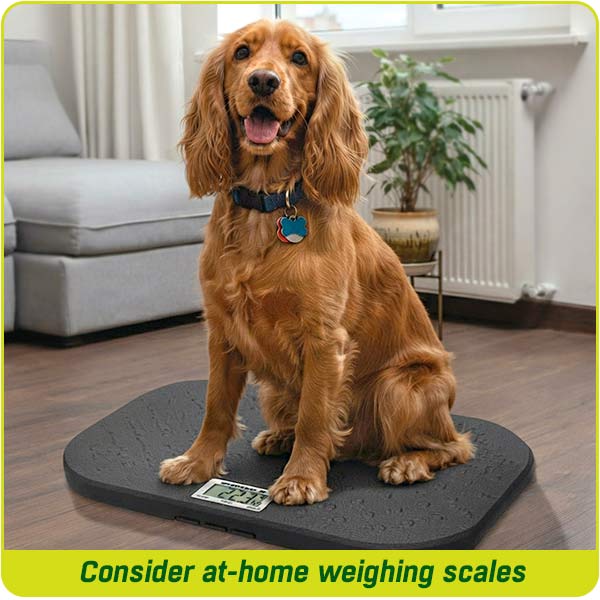
How to weigh your dog: Most household bathroom scales work if you use the “hold and subtract” method. First stand on the scales yourself and note your weight. Pick your dog up, stand on the same scales again, and note the new total. Subtract your weight from that total – the difference is your dog’s weight.
If your dog is too large or wriggly to lift safely, ask your vet or a local pet shop to use a walk-on platform scale; many will do this quickly and free of charge. Write the figure down with the date so you can track whether they are holding a lean weight or slowly creeping up. Remember, extra kilos mean extra stress on hips and joints every time they stand.
What’s in each tablet, and why
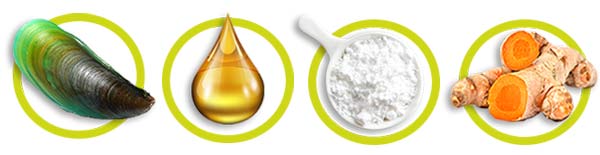
HIP+JOINT contains an impressive 764 mg of active ingredients per tablet. The blend is designed so the ingredients work together: providing building blocks for cartilage and support for joint fluid while also delivering natural compounds that help soothe stiffness.
Green-Lipped Mussel is exceptionally rich in natural Chondroitin; together with Glucosamine (in Hydrochloride form – the most effective for dog’s joints) and Hyaluronic Acid it is the core of the mobility formula.
MSM, Turmeric, Manganese and Vitamins C and E complete the tablet. Together they support comfort, connective tissue and antioxidant defence, so the formula works as a combination rather than as any single ingredient.
| Active ingredient | Per tablet | Why it is there |
|---|---|---|
| Glucosamine hydrochloride | 265mg | Supports cartilage structure and joint flexibility |
| MSM (methylsulfonylmethane) | 210mg | Helps comfort and connective tissue |
| Green-lipped mussel | 160mg | Natural source of chondroitin and omega-3s; supports lubrication |
| Turmeric extract | 110mg | Natural anti-inflammatory support (curcumin) |
| Vitamin C | 13mg | Supports collagen formation |
| Manganese | 3.5mg | Helps cartilage and connective tissue metabolism |
| Hyaluronic acid | 1.8mg | Supports the fluid that cushions the joint |
| Vitamin E | 0.8mg | Antioxidant support |
What to expect, week by week
| Stage | What is happening | What you may notice |
|---|---|---|
| Week 1 | Building the routine and “soaking” the joint area with actives | Most dogs show little change. That is normal. A few seem slightly more comfortable getting up or using stairs. |
| Weeks 2–3 | The novelty of a new pot wears off – this is when days start to get missed | Keep the habit. Effects build a little each day. |
| Weeks 3–4 | Steady daily use starts to show | Many dogs seem a bit freer on walks, quicker to stand, or more playful. Others are slower. Both are common. |
| Around week 6 | Maintenance after the loading phase | This is when many owners report clearer mobility changes. Some dogs take longer. Age and how worn the joints already are both matter. |
Week 1-4 reminder: Do not judge results too early. The first period of use is about building a routine, not instant relief.
Forgotten a serving?: Missed days slow progress. If you skip a day, just continue the next day as usual with no extra tablets.
How long to stay on the tablets?: HIP+JOINT is entirely safe to use long-term. The point when your dog starts to show positive changes is the best time to commit to maintaining the great work you’ve already put in building a routine. Slackening off may see their condition slide backwards.
Look out for these key signs:
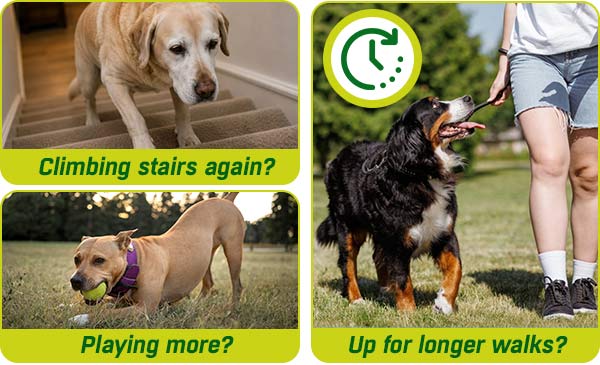
HIP+JOINT is not a quick fix. Some dogs feel less stiff an more comfortable moving within a few weeks, or less. For many, the bigger improvements come with regular daily use over a longer period. Try not to judge the results in the initial month of use, just stick at it and let the affected joints fully absorb the active ingredients.
Complementary care boosts the benefits!
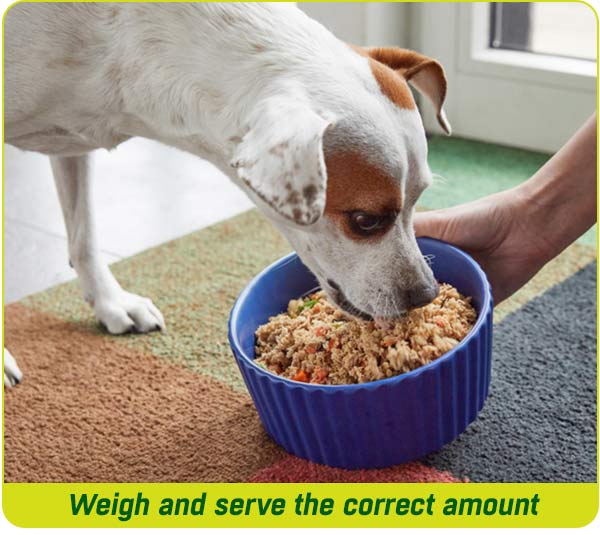
A supplement supports the joint from the inside. The load on that joint, how the dog moves and rests matter a lot too. Vets consistently put weight control and appropriate exercise near the top of non-drug joint care, plus hydrotherapy and home changes.
1. Keep an eye on your dog’s weight
Extra bodyweight means extra force going through hips, elbows and knees with every step. Maintaining a lean condition (often described as around 4.5 out of 9 on a body condition score) is one of the most effective things you can do to relieve the worst effects of Osteoarthritis. Calorie control is a smarter approach than extra walks if the dog is already sore. Ask your vet for a target weight and a feeding plan; weigh-ins keep are a good way to track progress and adjust your approach as you go.
Practical Tips:
- Measure food rather than free-feeding.
- Keep human food off the menu. Table scraps, licked plates and extras add calories fast and make a measured daily ration almost impossible to stick to.
- Remember to count their treats as part of the daily calorie total.
- When you start restricting calories to reduce weight, do it gradually so muscle is not lost with the fat.
2. Match exercise to their joints’ condition
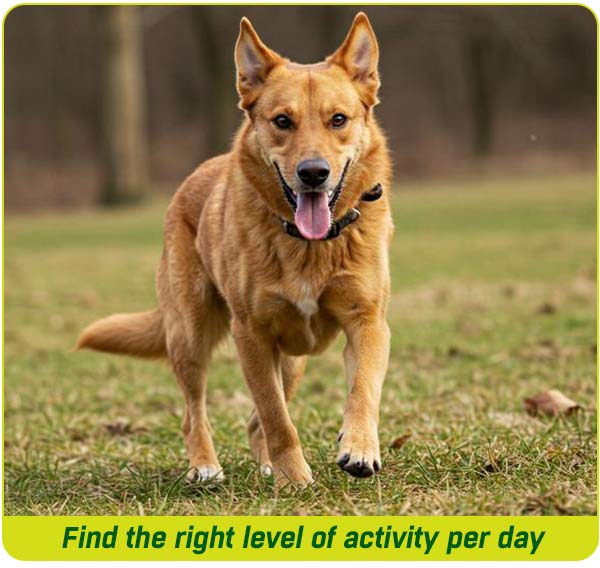
Rest helps recovery, but it’s not the whole answer. Unused muscles weaken and joints stiffen when dogs spend too much time without moving. Your aim should be regular, low-impact movement, appropriate to what your dog can handle comfortably rather than a lot of time lying down and occasional physically-demanding outings.
What usually works well:
- Several shorter leash walks rather than one long outing.
- Keep them on even surfaces where possible; avoid repeated ball-chasing and sharp turns if those leave them stiff the next day.
- Warm-up at the start of a walk, starting gently and winding down with a slower last few minutes at the end.
What often makes things worse:
- Sudden intense bursts after a week of little activity.
- Jumping in and out of the car or off the sofa.
- Slippery floors or uneven surfaces that force awkward footing.
If you are unsure of how much is enough for your dog, a vet or canine physio can set a simple weekly plan.
3. Hydrotherapy
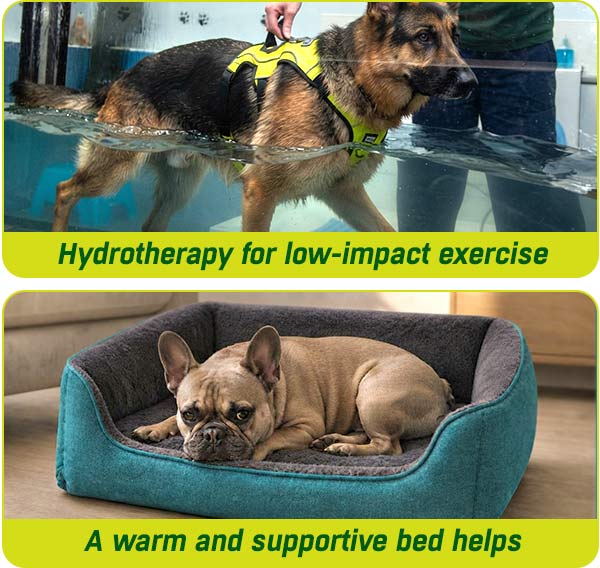
Water takes weight off the joints but still allows a dog to work their muscles. At chest depth, a dog bears under half their weight on land. Warm water also helps dogs with stiff joints to move more freely. Common options are a heated swim and an underwater treadmill (water depth/speed can be adjusted). Typical programmes involve a few 15-30 minute sessions a week, getting longer as the dog becomes used to the water.
Hydrotherapy pairs well with a daily joint tablet regime: one supports the joint chemically, the other trains strength and maintains range of motion with lower impact. It is also useful for overweight dogs who cannot walk far on land without paying for it later. Always use a proper canine hydrotherapy centre, and check with your vet first for any skin diseases, heart or breathing issues and take special care if your dog has recently had surgery.
4. A bed that actually supports them
An ordinary cushion or thin-walled dog bed may see hips and elbows sinking onto a hard floor and allow cold and damp to get into the joints making them feel worse. An orthopaedic or memory-foam bed cushions pressure points and makes getting up less of a struggle. Place it somewhere warm, draught-free and easy to step onto – not at the bottom of a flight of stairs they then have to climb for example.
5. Small changes that add up
Just like older people, your dog needs a bit more support and a few adjustments to live comfortably in their golden years. These adaptations cost little compared with the big improvement they can make to your dog’s day to day life. Check the table for some further ideas.
6. Other therapies worth asking your vet about
Depending on the dog, after a full consultation a vet may also suggest physiotherapy and home exercises, massage, laser therapy, acupuncture, or a prescription pain plan. Joint tablets sit alongside those options; they do not replace a diagnosis or prescribed medicine if the dog is in pain.
| Small Change | Why it helps |
|---|---|
| Ramps or pet steps for sofa, bed and car | Cuts jumping, which jars hips and elbows |
| Non-slip runners on laminate or tiles | Stops slipping and twisting |
| Raised or tilted bowls if neck or front legs are sore | Less strain when eating and drinking |
| Slings / support harnesses for stairs & uneven ground | Lets you take some weight off hind legs |
| Keep nails trimmed | Over-long nails change how the foot lands |
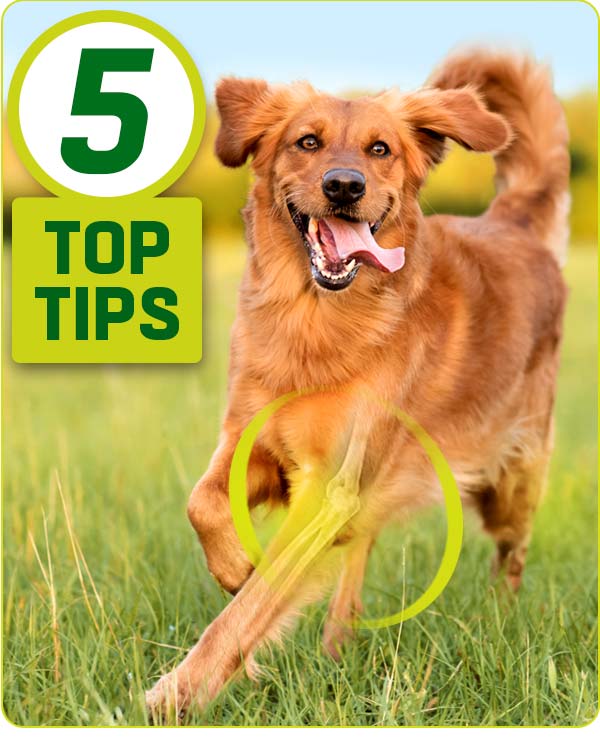
5 joint-care hacks most people miss
Alongside your regular tablet routine, a lean weight and a decent bed these tips come up again and again from rehab vets and owners who have already tried the obvious stuff.
1. Don’t judge today’s walk while you are still out
Arthritic dogs often seem fine during a walk and pay for it 6-24 hours later. If they are slower to get up the next morning, that outing was too much – even if they were pulling at the lead at the time. Shorten the next few days rather than “walking it off”.
2. Warm the dog up indoors before the front door
Stiff & sore joints hate a cold start. 2-3 minutes of slow walking around the house, a couple of easy sit-to-stands & then out. Skip stairs as the first thing they do. On frosty mornings a coat and a shorter, flatter course beats a long blast in the cold.
3. Coming down is harder than going up
Jumping off the sofa or out of the boot slams the front legs. Going down stairs does the same. A ramp with a gentle slope is kinder than pet steps. If stairs are unavoidable, a rear-support harness lets you take some weight and slow the descent.
4. Give the paws something to grip
Long nails and fur between the pads make laminate flooring and tiles feel like ice. Trim both. Rubber-backed runners placed from bed to bowl to door stop the scramble that twists hips and knees. Owners who cover the “commuting” routes around the house often notice easier getting-up within a week.
5. Swap the ball launcher for a sniffy walk
Repeated ‘Sprint-Stop-Turn’ exercise is one of the surest ways to aggravate sore joints. A slower walk with time to sniff works the muscles and the brain with far less impact. Heat (a warm pack wrapped in a towel, 10 minutes) before activity can loosen stiffness; a wrapped cold pack after they have overdone it can settle a hot joint. Never put heat or ice straight on skin, and let them move away from it.
These tactics won’t replace the benefits of HIP+JOINT, they just stop the day-to-day knocks that cancel out a good supplement routine.
Putting it all together
An average week
- Every day: HIP+JOINT tablets served with the same meal, measured food and a supportive bed.
- Most days: Sensible walks on a largely flat surface.
- As needed: Hydrotherapy or Physio sessions.
- Ongoing: Help keep them a healthy weight, make adjustments in the home, reduce jumping and monitor how they are in the morning after a busy day.
That combination; a regular routine of tablets, reduced strain on the joints and the right level of activity is how most owners get the best results from HIP+JOINT.
Keep the routine going
That is all you need to do for now: a regular serving, same time each day, with food. Double the serving for the first 4-6 weeks if your dog is new to joint supplements. Pair it with a leaner frame, kinder exercise and a comfortable place to lie down.
When the pot starts to run low, restock before the gap appears – consistency is the part most people underestimate. Regular use, over a long period is what will allow HIP+JOINT to work to its maximum.
Also available in 180- and 900-tablet packs, and as HIP+JOINT chews if your dog prefers a treat format.
*This page is general guidance for using CANIVET HIP+JOINT and supporting mobility at home. It is not a veterinary diagnosis. If you are worried about your dog’s joints, start with your vet.